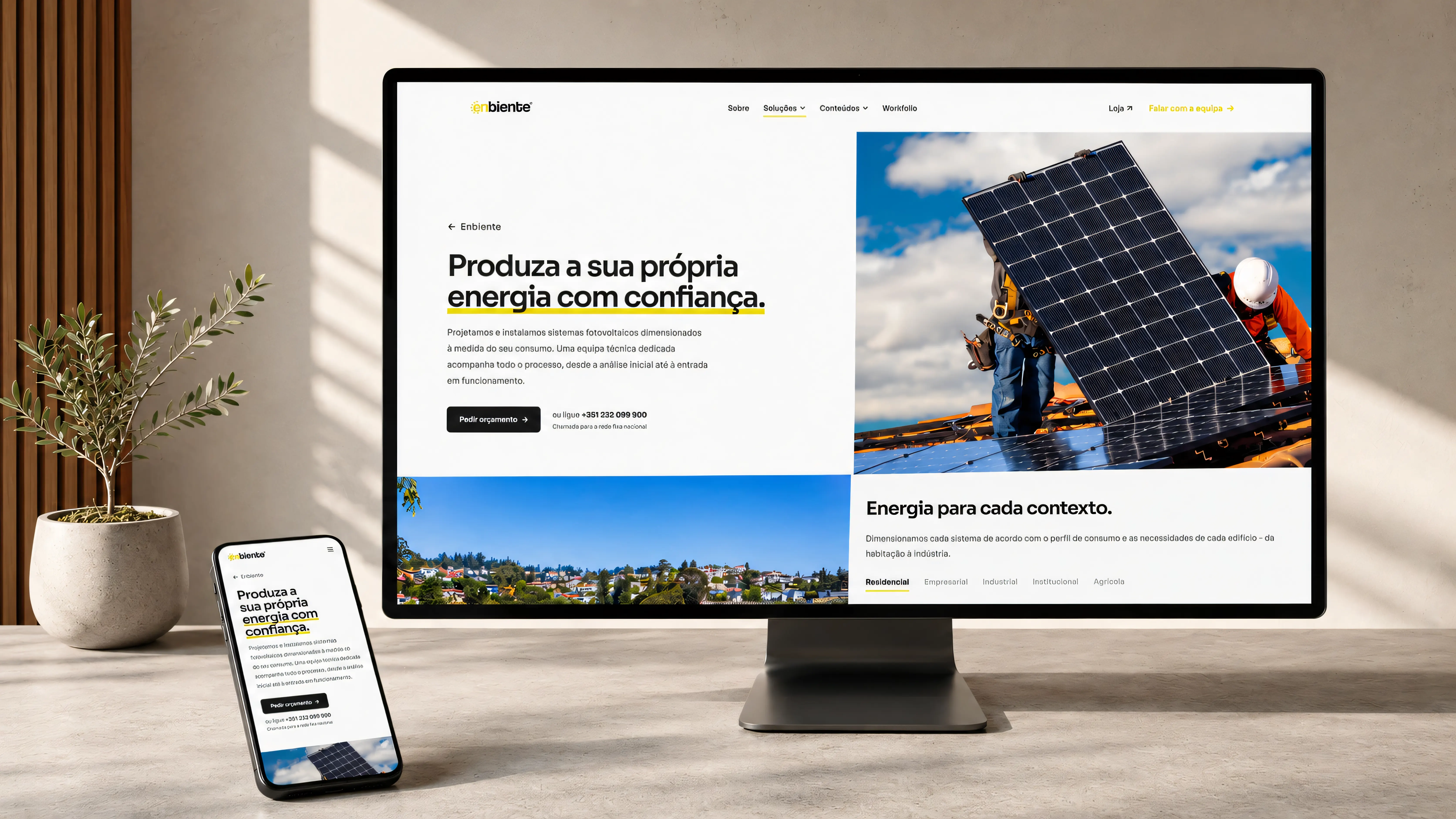

We automated Enbiente with AI
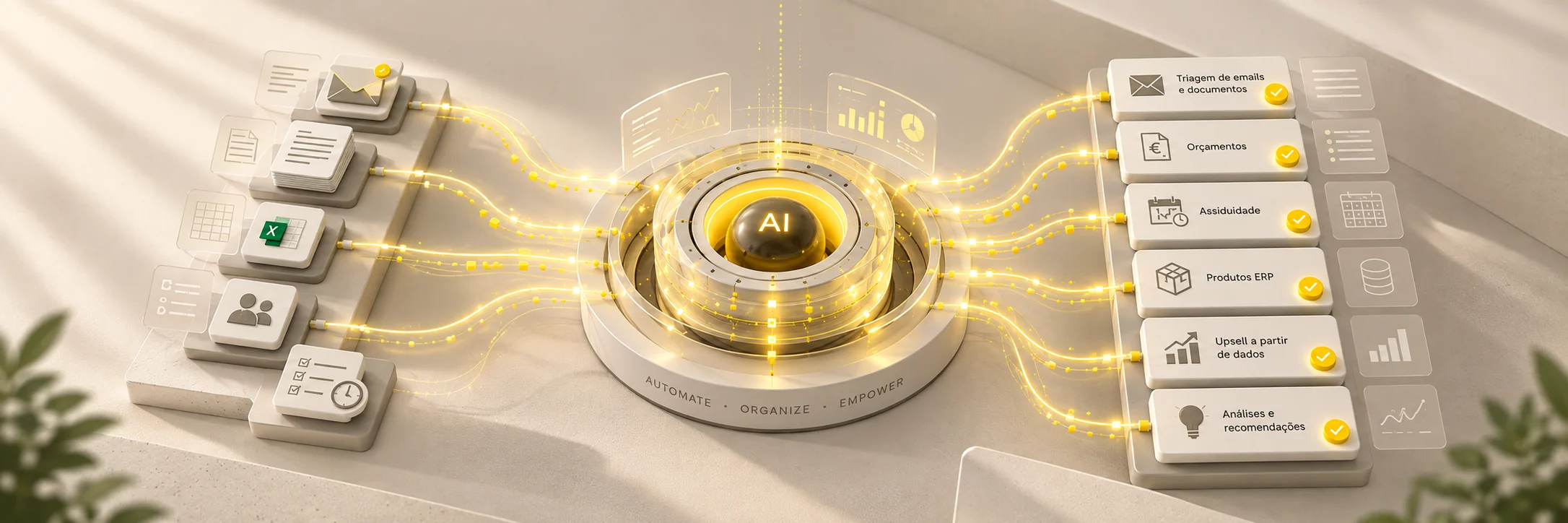
Enbiente wanted to use technology the way it recommends to clients. We built AI automations that free people from repetitive work: email triage, a customer-service chatbot, quotes, attendance, ERP product creation, contact cleaning and enrichment, and data-driven upsell.
- Client
- Enbiente
- Line of work
- AI & automation
- Location
- Viseu, Portugal
- Year
- 2026
Results
- AI workflows running in the operation
- 8
A company that recommends automation to its clients and does not use it at home has a credibility problem before it has an efficiency one.
Enbiente decided to solve both at once: take the triage, the paperwork and the same old emails off people, so there is time left for what is interesting and creative. Beyond the everyday AI tools, we built automations and workflows fitted to the operation.
The challenge
Like many SMEs, Enbiente had processes that worked, but at the cost of repetitive hours: sorting incoming mail, gathering prospect data in order to quote, closing attendance at month end, creating products in the ERP, looking for opportunities in client data. Necessary work, but work that consumes people and does not scale. Enbiente wanted two things at once: to be more efficient, and to be at the front of the technology it helps its own clients adopt.
Why we started with ourselves
Being your own client changes what you learn. There is no brief telling you where it hurts: there is a month-end close, a salesperson complaining about the same tab opened for the third time, an email that went unanswered. And there is nobody to hand the failures to.
Nearly every one of these workflows went through a version here that did not work before reaching the one that runs. That is the difference between knowing a quoting automation is possible and knowing where it breaks in month three.
What we built
We designed a set of AI automations, each aimed at a concrete point where time was being lost: from sorting incoming mail to answering the questions customers ask most, drafting proposals, closing attendance, managing the Odoo catalogue, cleaning and enriching contact records, and spotting opportunities in client data:
What each one does
Email and document triage. Reads the incoming mail, works out what it is about and routes it, instead of leaving everything in one inbox waiting for someone to open it.
Customer-service chatbot. Answers the questions that repeat, at any hour, and hands the team whatever falls outside what it can answer with confidence.
Data gathering and quotes. Runs the email conversation still needed in order to quote, collects what the customer answered and drafts the proposal from it.
Monthly attendance report. Closes the month from the records, instead of someone adding them up by hand on the first day of the next one.
Guided product creation. Creates products in the ERP with the catalogue in view, so the same article does not arrive twice under two names.
Contact cleaning. Finds the same customer recorded twice and proposes merging the records, flagging too what was created by mistake.
Contact enrichment. Takes a record holding little more than a name and fills it with what is public about that company.
Data-driven upsell. Reads what the client's systems already say and flags where there is an improvement worth proposing.
What stays with people
None of these workflows decides on its own what matters. The proposal is drafted, not sent: whoever signs it reads it first. Cleaning marks duplicates and proposes the merge, but does not delete, because merging two customers who turned out to be two is worse than holding one record too many. Enrichment fills what is empty and flags when what it finds disagrees with what was there, rather than writing over it. The chatbot answers what it knows and hands over the rest.
The rule is always the same: automation takes the work that is repeated and reversible, people keep what needs judgement and what is hard to undo.
What we measured
We instrumented our own CRM to see what had changed, and the honest answer is that it was not speed.
We expected to find faster responses. What we found was that they were already fast: before any automation existed, half of all quotes went out within the first hour of the contact arriving, and the median sat at a little over an hour. After the workflows, the median is one hour. There was no delay there to remove.
The number that looked best did not survive being checked. Average time to close a deal had dropped sharply after the automations, but only because the deals that arrived afterwards had not yet had time to take long: the slow ones were not in the average yet. Measured by the date a deal closes, rather than the date the contact arrived, it had not dropped at all.
We publish this because it is what we found, and because an automation sold on a number that cannot survive being re-run in six months is a bad deal for everyone. What changed was not the clock: it was who does the work up to the point the clock stops.
The result
Enbiente's people stopped spending hours on repetitive work and started spending them on what needs a human head and hand. Automatic data gathering lets the company talk to more prospects without growing the team; the ERP database stays clean; the opportunities that were hidden in the data reach the client as useful recommendations. And, as important as the efficiency: Enbiente now lives inside the AI and automation it proposes to its clients.
Built with
 Claudemodel
 OdooERP
 n8norchestration


About Enbiente
Enbiente is an energy and sustainability company based in Viseu: solar, HVAC, wind, and the monitoring that follows, from design through to operation. enbia is the part of Enbiente that builds software, so this case is work done in-house.