

We rebuilt Enbiente's website from scratch
We swapped Enbiente's Magento site, locked to a template, for a website of our own: bespoke, fast and with direct integrations. Enquiries now arrive almost three times faster.
- Client
- Enbiente
- Line of work
- Websites
- Location
- Viseu, Portugal
- Year
- 2026
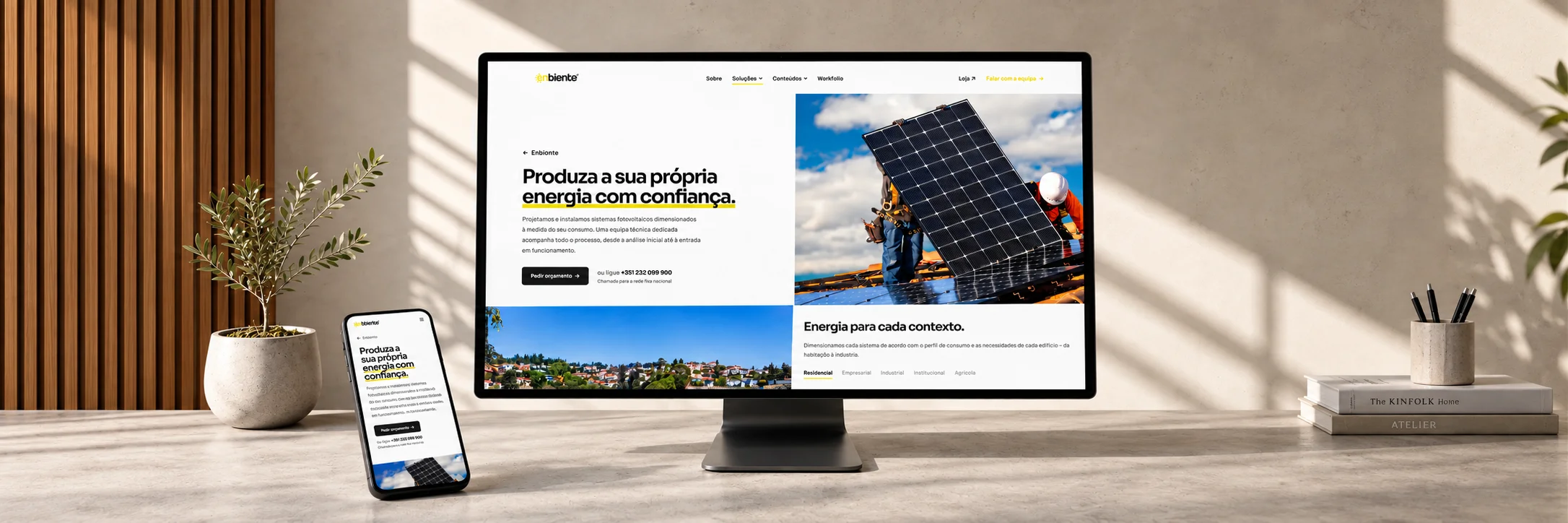
The content was right. What stopped the site saying what Enbiente does was the technology underneath it.
The company had to fit a template instead of drawing its own. We rebuilt the site from scratch, on the same stack that runs this page, and enquiries started arriving almost three times faster.
The challenge
The site started on WordPress, with a WooCommerce store that had stopped working properly. To fix the commerce side, Enbiente moved to a Magento setup. It fixed the shop. But it brought a bigger problem than the one it came to solve: the whole marketing site now lived inside Magento's template and page-builder components. There was no way to design the pages the company wanted, add the right components, or integrate the tools it needed. Every simple request ran into the same answer, which is the worst answer a tool can give the person paying for it: not like that.
Then there was the cost that never comes up in a meeting. A generic template loads what the template needs, not what the page needs, and that is paid for on every visit.
The shop is the part of the old stack that survived, and it stands as a marker of the starting point. The rest of the site scored on the same ground.
And the look felt dated, far from the credibility and innovation Enbiente wants to project. For a company selling technical systems to customers who buy once and need to trust, the website is the first demonstration of competence. It was working against them.
Results
- Enquiries per month, against the old site
- +178%
- Lighthouse performance
- 99
- Largest Contentful Paint
- 0.7 s
- WCAG 2.1 accessibility level met
- AA
The solution
We rebuilt the website from the ground up, on the same stack we use for this site: no CMS imposing limits, no template to obey. The content already existed and it was right. What changed was everything underneath it.
Every page is designed, not assembled
The institutional pages stopped being an arrangement of whichever blocks happened to be available and became composed. Hierarchy, rhythm and space sit where reading asks for them, rather than where the page builder left them.
Sections come from the content
Enbiente does not sell a product, it sells systems that combine with each other. The solution pages needed to show exactly that, and each one now carries the components its own content justifies, instead of the ones the catalogue happened to offer.
No two projects are presented the same way
The workfolio already existed, and adding projects to it was never the hard part. Presenting them differently was: every entry went into the same mould, because it was the only one the template could assemble. Now each page is composed for the work it describes. An installation whose client is willing to be quoted carries that testimonial; a job that explains itself in a photograph gets one full width, mid-page; a replacement shows before and after side by side; a filmed project opens on video. The format follows the material rather than the other way round.
Nobody had to ask the tool any more whether an idea would fit.
Integrations stopped being plugins
Meeting scheduling lives inside the contact page rather than on a third-party tab: a visitor picks the day and the time and confirms right there. The Google ratings are the real ones, read at source. Between the visitor and what they came to do there is no longer a layer of extensions to negotiate.
Commerce moved out of the way
We separated the shop from the marketing site. Commerce moved to its own subdomain, with its own life cycle, and the main site was left free to be simply what it needs to be. The decision also isolates the risk: whatever happens to one does not stall the other.
The result
In Lighthouse the site scores 99 for Performance, 100 for Accessibility, 100 for SEO and 100 for Best Practices, with Core Web Vitals green across the board: First Contentful Paint at 0.5 s, Largest Contentful Paint at 0.7 s, Total Blocking Time at 0 ms, Cumulative Layout Shift at 0, and a Speed Index of 1.0 s. Accessibility meets WCAG 2.1 AA.
The number that counts for the company, though, is a different one. In the two months since launch, enquiries have arrived at almost three times the rate the old site had been managing since January.
Underneath the numbers is the change that matters: Enbiente is no longer limited by the tool. It publishes, designs and evolves the site at its own pace, with an image that matches what it does.
See for yourself
The site is live. Load it right here, or open it in a new tab.

Built with
 Astroframework
 Reactinteractivity
- Tailwind CSSstyles


About Enbiente
Enbiente is an energy and sustainability company based in Viseu: solar, HVAC, wind, and the monitoring that follows, from design through to operation. enbia is the part of Enbiente that builds software, so this case is work done in-house.