
A camera that sees what matters, not who it is
An R&D project in computer vision, built into surveillance cameras: on a client's building sites it checks helmets and vests, watches the risk zones and follows the works; at the office door it counts who comes in. Everything is analysed next to the camera, with faces blurred.
- Line of work
- AI & automation
- Location
- Viseu, Portugal
- Year
- 2026
An ordinary camera records everything and understands nothing. We taught one to understand what matters, without letting it recognise anyone.
It is a research and development project of ours: a computer vision system that takes the video from a standard IP camera, finds the people in it, follows them across the frame and reads what they are wearing, in real time, on a small AI-accelerated computer installed next to the camera. The first client sells and rents equipment for building sites, and that is where the system checks helmets and vests, watches the machines at work and follows the progress of the works. At home, it sits at the door of Enbiente's office, counting who comes in.
The challenge
On a building site there are suspended loads, machines on the move and people walking underneath. A helmet, a vest and the rest of the personal protective equipment are often the difference between a scare and a serious accident, and nobody can watch the whole site all the time.
There are cameras almost everywhere, and almost all of them only record. To learn anything, someone has to watch the footage: whether everyone on site is wearing a helmet, how many people came in today, when the busiest hours are. Nobody does that work, so the questions go unanswered.
And it is not work for a rule. A rule can check whether a value has crossed a limit. Looking at an image and telling whether that person is wearing a helmet takes seeing, and that is exactly where artificial intelligence earns its place.
The products that do answer them usually send the video to the cloud, which raises two questions an SME should not ignore: what happens to the images of people, and how much it costs to send and analyse them every month. We wanted to prove the answers can be had on site, in real time, with ordinary equipment and without identifying anyone.
The solution
On site: helmet and vest
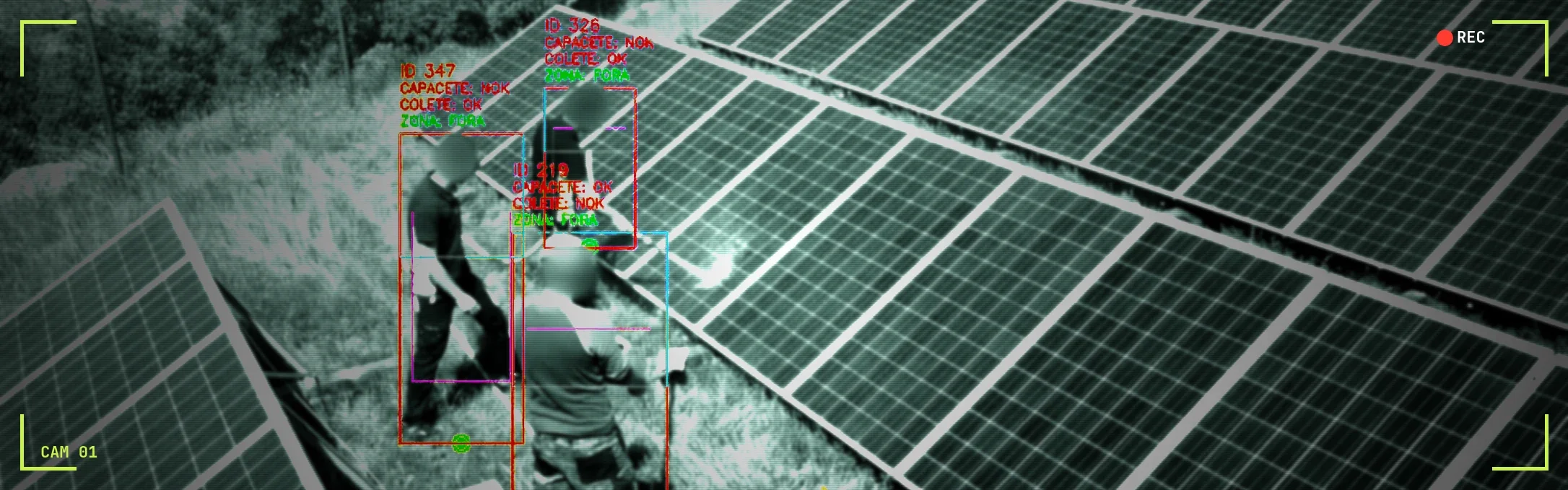
The system is built into the site's surveillance cameras, and the camera learns to tell whether the people on site are wearing their protective equipment. Every person detected gets a temporary number, and as they move the system checks whether they are wearing a helmet and a hi-vis vest, and whether they are inside or outside a marked zone. When something is missing, the lapse is flagged in red, in time to be put right. The video above shows it on drone footage of solar installations.
At the end of the day the system produces a summary map, so the person responsible for safety can see how well the rules on protective equipment were followed on site, without reviewing hours of recordings.
The risk zones
The same camera watches the machines at work: it helps confirm they operate within the planned conditions and protects what is around them. For now the risk zones are set by hand, and each one gets a level, from mild to extreme danger. Whenever there is risky behaviour in one of them, the system raises an alert. If an incident happens, the camera keeps a short clip of what happened before and after.
The progress of the works
The camera can also flag unauthorised entries and exits on the site and help follow how the works are progressing. We are testing a way to measure that progress from frames captured over time and from timelapses. The timelapses serve marketing and communications too, which get footage of the building going up to show clients and partners. The same installation serves safety, site monitoring and the company's communications.
At the office door
At home, the same base points at the entrance of Enbiente's office. The live screen shows how many people came through today, how many are in front of the camera and how long they stay, with a counting line drawn over the image and footfall hour by hour. Each person appears with a box and a number, and their face comes out blurred.
The reports answer the questions that come afterwards. By day, week or month: how many visitors, how many passes through each line and zone, and a heatmap of how long people spend at each point on the floor. Everything exports to HTML, PDF or CSV.
What it sees of each person is an estimate, and says so. Glasses, a hat, a backpack or bag, clothing, boots, an object in hand, the colour of their clothes: the system estimates what the camera can see and adds it up over the day, with the share it could not determine always in view.
How it is set up
There are three parts, and none of them is special: an ordinary IP camera (or a USB webcam), a small AI-accelerated computer next to it, and a browser to see the dashboard. The analysis runs on that computer and keeps running with the dashboard closed. The video does not need to leave the building.

To show the system to the public there is a mode of its own for a stand: a read-only screen, designed for a television, and an invitation to anyone looking at the camera to wave, with the wave celebrated on screen.
Privacy from the start
In a system that looks at people, privacy cannot be a hidden option. So it sits on the same page as everything else:
- Faces come out blurred in the video shown, in recordings and in saved images.
- Privacy masks cover parts of the image that must never appear, such as a desk or a screen.
- Nobody is recognised. Each person gets a temporary number that says nothing about who they are and is reset.
- Every characteristic can be switched off. Switched off, it is no longer analysed, shown or stored.
- The analysis stays on site, on the computer next to the camera.
What it can do for a business
The same base answers other questions. Checking protective equipment in a warehouse or a factory. Counting footfall in a shop, a reception or a trade-fair stand, and finding the peak hours. Seeing which parts of a space are actually used. And adding simple rules, such as an alert when a door is left open with nobody nearby.
Any of these starts with the framework: what can be filmed, who has to be told and what is kept. In Portugal, a camera in a workplace serves the safety of people and property, not the monitoring of the attendance or performance of the people who work there, and the system was designed to respect that line: it counts and describes, it does not identify.
The result
A system that runs in real time, at around fifteen frames per second, on an ordinary camera and a small computer, without sending video anywhere. On building sites the aim is concrete: to reduce the risk of accidents at work and of damage around the site, with a level of attention nobody can keep up all day. At Enbiente's front door, it counts who comes through.
It shows that computer vision is no longer a lab project for an SME: with the right setup it fits on a wall and answers the questions that used to go unasked.