
Kinopsis: a video for every proposal
Kinopsis is the video engine we built: it reads the record in the ERP or CRM, one AI agent writes the video, another checks it, and a person approves it before it goes anywhere. Proposals, presentations, case studies and infographics, for several brands, landscape and portrait, without ever reading a price.
- Client
- Enbiente
- Line of work
- AI & automation
- Location
- Viseu, Portugal
- Year
- 2026
Results
- Of test videos already sent to clients
- Dozens
- Minutes per render, depending on the machine
- 2 to 5
A proposal is easier to explain in a video, but nobody has time to make a video for every proposal. We built Kinopsis so each one can have its own.
Kinopsis is a video engine and a workspace for the team. It starts from what the company already knows (an opportunity in the ERP or CRM, a finished project, a blog article), one AI agent writes the video scene by scene, another checks it against the facts, and a person approves it before it goes to the client. Today it makes proposals, presentations, case studies and infographics, for three brands, landscape and portrait.
The challenge
A proposal is a PDF with a price. The client has to imagine the rest: what the structure looks like, where the energy flows, how much it produces, what changes day to day. A one-minute video about their own project explains that better than three pages, but made by hand it takes a designer hours, and those hours are not there for every opportunity.
AI video tools solve the hurry and create another problem: they make things up. They generate images that do not exist and sentences nobody confirmed, and that cannot go to a client about their own project. We wanted the speed without the invention.
The solution
From the record to the synopsis
It all starts from the record that already exists. You pick the opportunity and, before importing, you see exactly what will be read: the client, the quotations, the conversation and the files, each one chosen by hand. Prices never come in. No value, total or discount is read, and amounts written in messages are left out. The result is the synopsis: everything the video knows, and nothing more.
Written, checked, drawn
An AI agent, the author, writes the video from the synopsis: it picks the scenes, writes the words and sets the pace. It does not generate images. Every scene comes from the brand's kit, designed by us beforehand, and the author only fills it with the facts it has. So every image is on brand and every figure comes from the synopsis.
Before any time is spent rendering, the video is checked twice. First in code: the text fits where it should, no price appears, the scenes exist. Then by a second agent, the reviewer, which looks at an image of every scene and compares what is there with the synopsis. If something does not match, the video goes back to the author with the reviewer's notes. Only then is it rendered, which takes between two and five minutes, depending on the machine it runs on.

A person approves
Nothing leaves without a person. Whoever asked for the video watches it and approves it, or asks for changes in their own words, to the whole video or to one scene. The next version starts from the same synopsis and the reviewer's notes, and versions are compared side by side, scene by scene. Once approved, the video is published at a link, and the link goes back to the record in the ERP or CRM. Even then, nothing is sent on its own: the link reaches the client through a person.
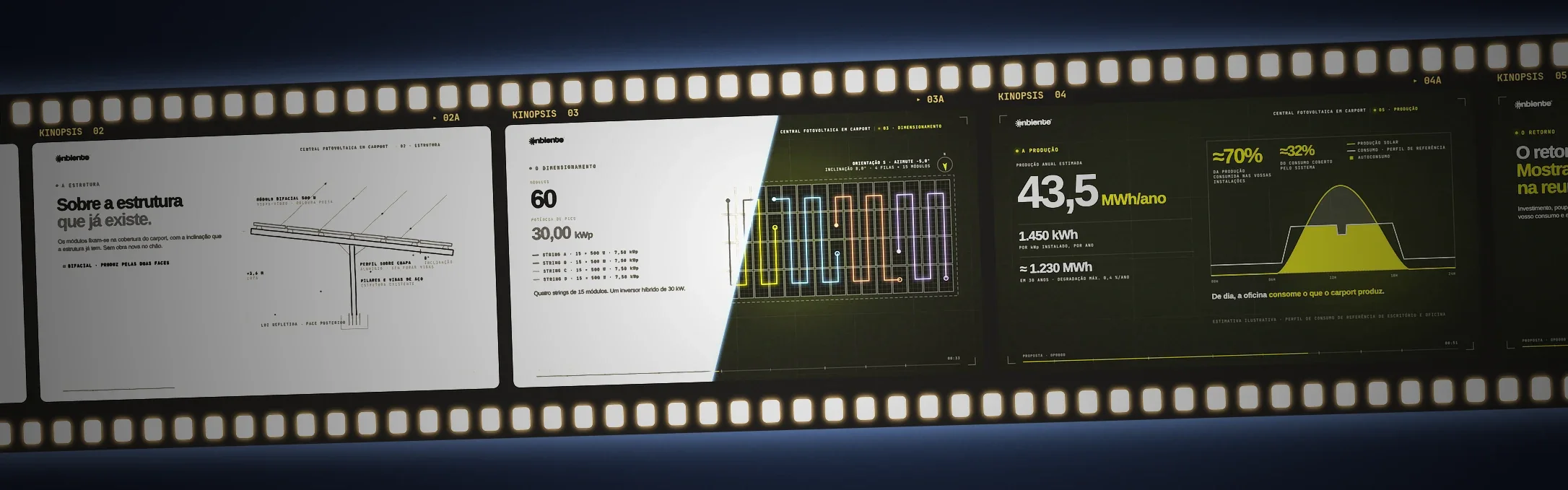
This is one of the test videos, made for an invented project: a solar plant on the carport of an example company. Notice the payback, which appears locked. It is kept for the meeting, like the price.
A proposal, as the client receives it
One engine, several brands
Each brand has its own kit: the scenes, the sounds and the identity. Enbiente and EnbiPower share a style of technical line drawings; enbia has its own, lighter and in violet. Adding a brand to a style that already exists means giving it a palette and a logo, not redrawing dozens of scenes. Every video comes out landscape, for email and meetings, and portrait, for social media, in Portuguese or in English.
Kinopsis runs on a company server, and the AI agents are a choice, not a dependency: we use Claude, but the engine is not tied to it, and whoever uses it can work with the agent they prefer.
What it can do for a business
It started with proposals, and the same idea fits any video that does not get made today for lack of time: the case study of a finished project, the infographic of an article, the presentation of a service, a product video from the catalogue. In every one, the ERP or CRM already knows the story. The video only has to tell it.
We are testing it in-house, at scale, and will make it available to other companies. If you are interested, talk to us.
The result
Kinopsis makes videos end to end: it reads the record, writes, checks, renders and publishes, with a person approving. We have already sent dozens of test videos to clients, and each render takes between two and five minutes. It is the second version of an engine that started with proposals alone, and it is in closed beta at Enbiente before it reaches other companies.
Built with
 Claudeauthor and reviewer
 Remotionvideo rendering
 Reactscenes and interface
 Node.jsserver
 Cloudflarepublishing

About Enbiente
Enbiente is an energy and sustainability company based in Viseu: solar, HVAC, wind, and the monitoring that follows, from design through to operation. enbia is the part of Enbiente that builds software, so this case is work done in-house.