

From a paper sheet to same-day yield
An internal platform that records pork breakdown piece by piece, from entry weight to final weighing, and shows each run's yield the same day.
- Line of work
- Websites
- Location
- Armamar, Portugal
- Year
- 2026
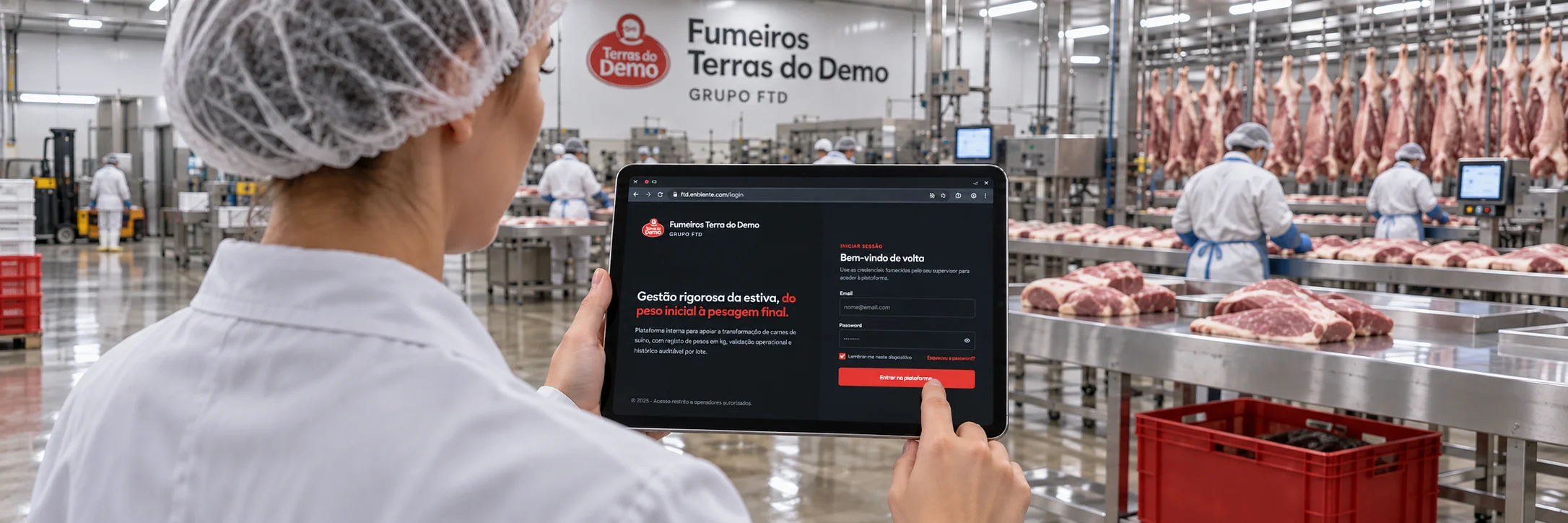
Every cutting room knows it loses something along the way. Few can say where.
FTD has been making charcuterie in Armamar since 1979: wood smoking, recipes from the region, and an ISO 22000 and IFS certified operation selling at home and abroad. They asked us for an internal platform that would record the estiva, the breakdown run, from the first weight to the last, and lay that difference bare, run by run, the same day.
The challenge
In most cutting rooms a yield deviation only shows up when the month is closed. By then it is too late to explain: hard, and often impossible, to pin on a particular supplier, operator or batch. What is left is a sense that something is being lost somewhere, without a number anyone can act on.
At FTD the information existed, which is already more than most cutting rooms can say: every piece of every carcass was weighed and written down by hand, sheet by sheet, every day. What was missing was not rigour, it was time. The sheets reached the office after they had stopped being useful, and rebuilding a month from them takes work, and what it produces at the end is an estimate, not an answer.
The solution
An internal web application, designed to be used beside the scale rather than at a desk. The screens were drawn for people working in gloves in a wet room, and the vocabulary is the trade's own rather than a generic product hurriedly relabelled.
What happens on the floor
Every run is a record, from the moment it arrives. Entry weight, supplier, batch, breed, the sheet and slaughter dates and the identification of the pigs are attached to the run before cutting starts. That is what later makes it possible to answer where and with whom, not just how much.
Weighing follows the plant's own structure. The operator works from the house catalogue of pieces, from the parent piece down to the sub-pieces it divides into, with a diagram of the animal marking the section in hand. Every piece carries the plant's own internal code, the same one printed on the paper sheet, so nobody has to translate anything. Anyone who does not yet know the catalogue by heart is not left waiting on someone who does. What is entered is kept as it goes, with nobody having to stop and confirm, which is one of the reasons the record actually gets made instead of being left to the end of the shift.
Only the tip of the tree counts. The catalogue is a tree with no fixed depth: a sub-piece is simply a piece that has a parent, and that one may have its own. Only weighed pieces whose sub-pieces were not weighed enter the balance: counting both would be weighing the same meat twice. The same piece counts on one run and not on the next, depending how far down the detail went that day. The carcass itself never goes on the scale: its weight is the one recorded in the header, on arrival.
What is sold, Desperdício/M3 and shrinkage are three different things, and they are counted separately from the start. What goes out for sale is the only one that counts towards valuation. Desperdício/M3 (category 3 material) crosses the scale, enters the weight and is worth zero. Shrinkage is what was never weighed at all: the meat left on the table, on the knife, evaporation. Confusing them is one of the most common reasons a plant ends up with yield figures nobody trusts.
The balance stays in view. While weighing is under way the arithmetic keeps up: what came in, what has been weighed so far, and the difference between them, in kilograms and as a percentage. A misread stops being something discovered at the end of the month and shows up at the scale, while the piece is still on it. Shrinkage can come out negative, and that is not a flaw to hide: it means the pieces weighed more than the carcass, and it is a sign that something does not add up, not a number to round back to zero.
What the platform will not let past
On paper, what nobody can explain ends up forgotten. Here, it stays open.
The arithmetic closes before the record does. When cutting ends the pieces have to add up to the weight that came in, within the margin the plant has set, and the platform checks that on its own. Each rule decides what to do with its own deviation: raise an alert, require a written explanation before finalising, or block the close outright. Two situations always block, whatever is configured: the pieces weighing more than the carcass that came in, and the sub-pieces weighing more than their parent. Neither is possible in a cutting room, and letting them through would contaminate every average from that point on.
Not every alert comes from a written tolerance. A run well outside what usually happens with that supplier is flagged by comparison with that supplier's own history, rather than against a plant-wide average, which dilutes exactly what was worth seeing.
The explanation stays, and so do the rules. Who explained a deviation, when, and in what words is kept with the record, and the rules in force at the time stay attached to it. Today's verdict still reads a year from now, even if the tolerances have changed in the meantime. What the plant gets is a history it can search, and show in an audit, rather than a conversation nobody quite remembers.
Prices do not rewrite the past. Each piece can carry a yield target and a valuation in euros per kilo. The target is a percentage of the whole carcass rather than of the piece it came from, and the sub-pieces' targets can never add up to more than their parent's: what sits between the two is the loss of the cut itself. The deviation against target shows per run and per period, with the option to drill down to the piece that caused it. When a price changes, the change is recorded (the old value, the new one and who touched it) and runs already closed keep the valuation they closed with. That is the difference between this and a spreadsheet, where updating one price silently rewrites the entire history.
What reaches whoever decides
The dashboard answers the questions that come down from management. Whether yield is rising or falling, which suppliers deliver better, which operators and which breeds yield more, how much Desperdício/M3 weighed in the quarter, how much margin was left between what the carcass cost and what the cutting was worth. Beside it sits the list of unresolved runs (those left unexplained and those the engine ruled invalid), which is the working list for whoever supervises the room.
Things come out, and go in, without retyping. Each run produces its own report, ready to file or hand to a customer, and listings export for anyone who would rather work the numbers in their own spreadsheet. In the other direction the piece catalogue, the suppliers and the margins load from a file, which is what gets the system running in days instead of weeks of manual entry.
There is an assistant you can ask in plain Portuguese, over the plant's own data and respecting the permissions of whoever is asking, plus a daily summary of what changed for anyone who wants the essentials before the first meeting of the morning. It is optional: a plant that would rather not use it turns it off.
Everyone sees what concerns them. The operator their own runs, supervision the room and the catalogue, management the whole. Accounts are created by invitation from an administrator and the password is set by the user, through a link sent by email. The application carries the company's name, logo and colours, on screen and in the messages it sends.
Built with
 Reactinterface
 Node.jsserver
 PostgreSQLdata
The relational database holds the piece tree and the per-batch history, the part of the platform that has to still make sense a year from now, when someone comes to check a batch nobody remembers weighing.
The result
A run's yield stops being a conclusion drawn at the end of the month and becomes available the same day, while the batch is still on the premises and while there is still a conversation to be had with whoever supplied it. The underlying change is not how much information there is, it is when it arrives: what was an estimate rebuilt from paper becomes a record made while the work happens, by the people doing it.
The platform is in use at FTD, in testing and tuning, with the room moving onto it in stages, at the pace a certified operation changes a process that already works.
About FTD
FTD, Fumeiros Terras do Demo, started with José Cardoso and today has two production sites in the Viseu district. The name comes from the region Aquilino Ribeiro called Terras do Demo. The company works traditional and industrial charcuterie, sliced products, and fresh and frozen meats.