

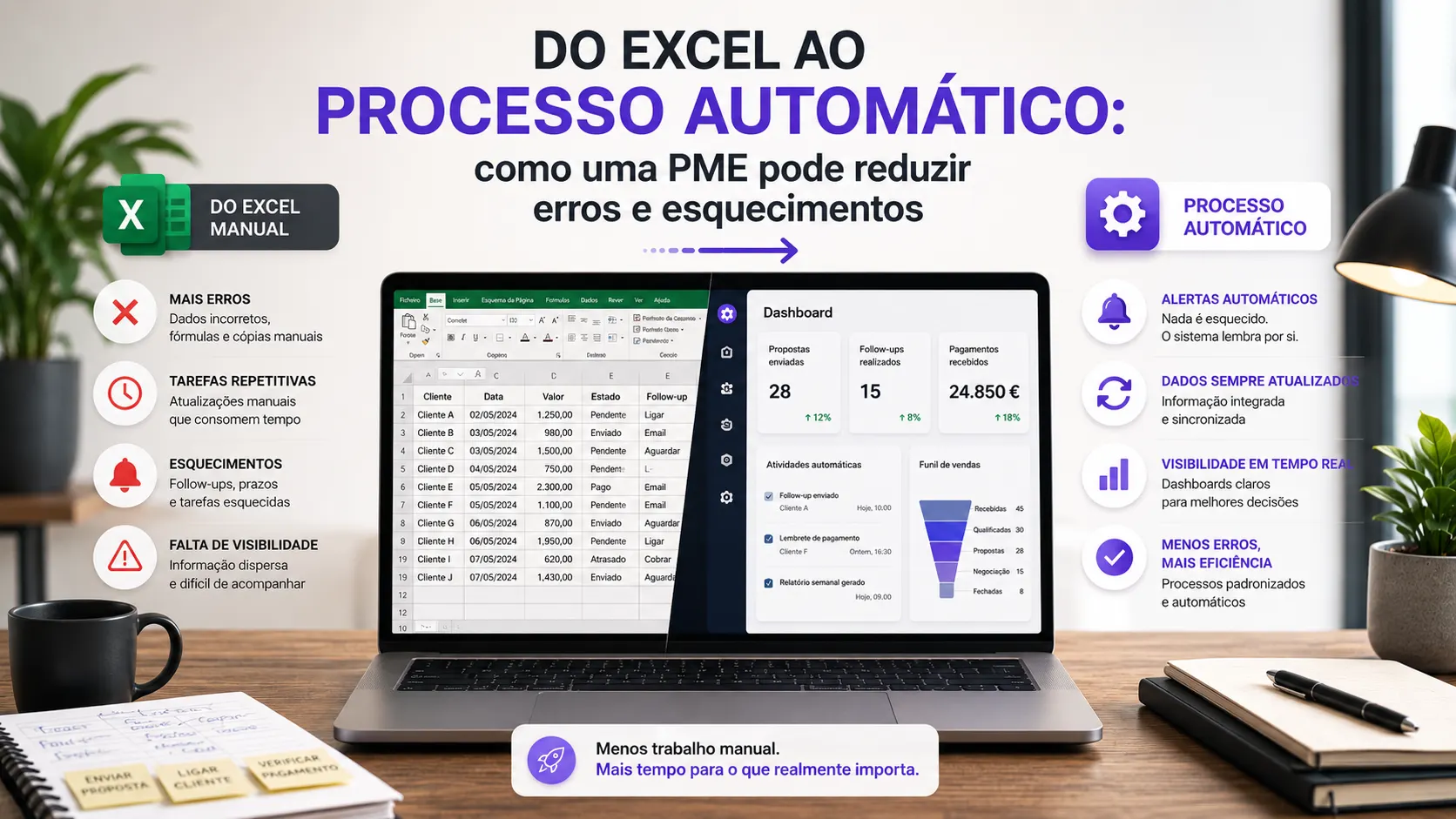
From Excel to an automated process: how an SMB can reduce errors and forgotten tasks
Published on 2026-05-25 · by Catarina Costa
Productivity Digital Transformation
For years, Excel has quietly become the operational backbone of thousands of small and medium-sized businesses.
It is everywhere. In sales proposals. In financial dashboards. In reports. In inventory. In collections. In customer lists. In internal planning. In tasks small, medium, and critical.
And the truth is, the problem was never Excel.
Excel remains an extremely useful, flexible, and powerful tool. The real problem begins when a company's entire operation depends exclusively on manual updates, data copying, and human memory to function properly.
That is precisely where the errors start to appear.
The invisible cost of manual processes
- A row deleted by accident.
- A document sent in the wrong version.
- A forgotten follow-up.
- A task left “for tomorrow”.
- A value changed manually and never validated.
At first glance, these look like small, unimportant mistakes. But when they happen daily, they begin to create operational strain, delays, rework, and lost productivity.
And perhaps the most dangerous part is this: many companies have grown so used to working this way that they no longer even question the time being lost.
Entire teams spend hours every week copying information between platforms, updating Excel sheets by hand, and checking the same data over and over again just to make sure “everything is right”.
Not because it makes sense. But because it has always been done this way.
Automating doesn't mean starting from scratch
There is a very common misconception in SMBs: that automating processes means replacing everything that already exists.
In reality, most companies do not need to immediately abandon the tools they use every day. The goal is not to create more complexity. It is to reduce dependence on repetitive tasks and minimise human error.
And often, the transformation starts precisely with the small routines that consume the most time.
- An incoming email can automatically create an internal task.
- A sent proposal can trigger an automatic follow-up days later.
- An overdue payment can generate notifications without any manual intervention.
- A dashboard can update itself in real time.
Small automations quickly start creating operational impact.
When processes stop depending on human memory
Much of the operational chaos in SMBs comes from the fact that too many tasks still depend on people's heads.
- Someone has to remember.
- Someone has to check.
- Someone has to update.
- Someone has to follow up.
And as a company grows, that model inevitably starts creating bottlenecks.
When processes become automatic, operations become more predictable, organised, and efficient. Missed tasks decrease, errors drop, and teams stop losing energy on work that could already be happening on its own.
This doesn't replace people - it frees them.
The future of SMBs will be simpler, not more complicated
For a long time, automation seemed distant from the reality of small businesses. Today, that is no longer the case.
Technological evolution has made it possible to build intelligent processes without massive projects, excessive complexity, or impossible investments.
And perhaps that is the biggest change: SMBs no longer need to operate the way they did ten years ago.
At enbia, we help companies turn manual processes into smarter, more organised, and more efficient operations - without complicating what already works.
Because often, the difference between a constantly overwhelmed company and one ready to grow comes down to a simple shift: stopping the manual work for things that could already be happening on their own.